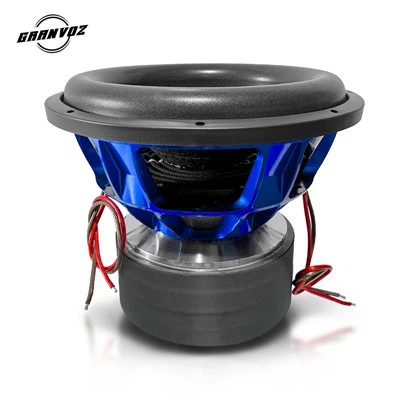
Full-range speakers vs. tweeters: Which is better for your needs?
It is obvious that the choice of speakers in any audio system will have a proportional impact on the sound performance. Common speakers include full-range speakers (FRC) and tweeters, and their respective design functions are closely related, but also different. Now it is time to answer another question: What is the main difference between these two speakers? What advantages do they each bring? Finally, what factors need to be considered when choosing a speaker? This article will answer these questions in detail from multiple angles.

What is a full-range speaker?
Speakers that can reproduce the full frequency range are called full-range speakers. Full-range speakers can play low frequencies, mid-range frequencies, and even high frequencies. Such speakers are often used in small speakers, portable stereo systems, car audio, etc. to achieve complete sound reproduction in one device.
What is a tweeter?
Tweeters reproduce high-frequency sounds, usually between 2kHz and 20kHz, allowing listeners to hear fine high-pitched details, such as sibilance in singing, overtones of string instruments, and air in ambient sounds. Tweeters are often paired with another speaker (such as a woofer/midrange) to extend the frequency response.

What's the difference?
Full-range speakers typically have a frequency range of 50Hz to 15kHz. Most tweeters handle frequencies from 2kHz to above 20kHz. Full-range speakers are suitable for portable audio systems, small sound reinforcement systems, and even background music; tweeters are best suited for high-end audio systems, Hi-Fi systems, or sound reinforcement systems. Full-range speakers can produce a balanced sound, but with high- and low-frequency details. Tweeters can produce a solid and perfect high-frequency performance, but cannot reproduce low-frequency content. Finally, full-range speakers can be used independently, and tweeters are usually used in conjunction with woofers or midrange speakers.
Advantages and Disadvantages
The most important feature of full-range speakers is of course their simple construction, which may make people feel that using an overly complex "crossover" in a sound system is luxurious; therefore, it is often used as a stand-alone system in a compact sound system. In addition, its inherent frequency clarity reduces the phase distortion caused by the crossover. However, due to the need to balance low frequency, mid-range and high frequency, its overall performance may not be as good as that of professional units, and the high and low frequency performance is weak, especially the treble details are not as good as professional tweeters, and distortion may occur at high volume.
The advantage of tweeters is that they can show clear and transparent high-frequency details, which is suitable for high-end audio systems to make the sound more layered. Tweeters are indispensable for Hi-Fi or professional audio systems. However, tweeters cannot be used alone, but must be used with bass/midrange units, and a suitable crossover is required to control the frequency clarity, otherwise it is easy to cause distortion.
How to choose a speaker that suits you?
The choice of full-range speakers or tweeters mainly depends on the applicable scenario, sound quality requirements and budget.
If you are upgrading the original car audio, listening to songs on daily commuting, or the owner who does not require high sound quality, full-range speakers are a good choice. If it is an audiophile modification, a high-fidelity audio system, or a pursuit of a richer sound field, the combination of high and low frequencies will provide better sound quality.
If you are looking for simple, easy-to-use, and balanced sound quality, full-range speakers are a more suitable choice, especially suitable for directly replacing the original car speakers. They are easy to install and basically do not require additional adjustments. If you need more delicate treble details and a wider sound field, it is recommended to choose a tweeter with a suitable bass/midrange unit and amplifier, which is suitable for car owners who like high-fidelity music or large dynamic music.
Full-range speakers are suitable for people with limited budgets who want to reduce the complexity of matching, while tweeters usually require additional crossovers, mid-bass speakers, and amplifiers, so the budget is higher, suitable for professional modifications or people who pursue sound quality.
Do you need a tweeter?
Whether a car audio system needs to use a tweeter depends on the requirements for sound quality, system configuration, and personal listening habits. Most of the original car speakers are full-range speakers, which lack high-frequency details and easily lead to blurred sound. If you are looking for clear vocals, instrument details, and better sound field effects, tweeters are indispensable. On the other hand, if you only use the audio system in daily driving and do not require high sound quality, then the original full-range speakers can already meet basic needs, and there is no need to install an additional tweeter. If the original car audio system has a crossover or DSP and requires a tweeter to optimize frequency clarity, then you may need to equip the tweeter with an amplifier, which is an additional cost in the modification.
For users who do not require high sound quality, full-range speakers are good enough, but tweeters are undoubtedly one of the keys to achieving high performance in car audio. Granvoz is committed to creating high-quality car speakers and is committed to providing a full range of professional car audio solutions. Granvoz products cover multiple series such as full-range speakers, tweeters, mid-bass speakers, etc., and have won the favor of many car audio modification enthusiasts with their accurate sound reproduction, excellent dynamic performance and reliability. If you are looking for high-quality car speakers, Granvoz is undoubtedly your ideal choice.