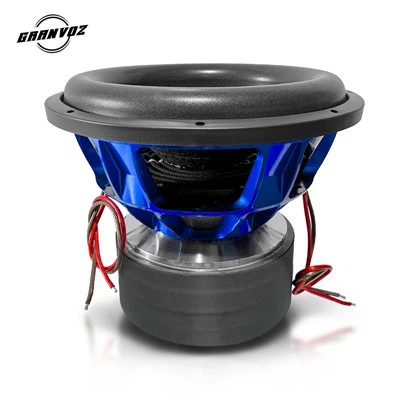
In the development history of speakers for more than 100 years, material selection, process spread and structural form have been changing. Different materials and qualities create different sound characteristics, and each has its own advantages and disadvantages. Currently, the four popular speaker diaphragm materials on the market include paper cone, plastic, metal and synthetic fiber.
01 paper cone diaphragm
The paper cone diaphragm appeared earliest and is also the most common speaker diaphragm material. It currently has a very mature technical level. The production process is roughly as follows. The pulp is poured into the designed mold, dried and then subjected to a series of subsequent processing. The specific material composition, proportions, and processing methods are different for each brand and are their commercial secrets.
The sound characteristics of this diaphragm are smooth and natural, with few distinctive and exciting parts, which is in line with the taste of most people. Due to the interweaving of internal fibers, the paper cone diaphragm can quickly absorb the sound energy during transmission, so the damping characteristics are ideal. In addition, the paper cone also has the advantages of light weight and high energy conversion efficiency. The disadvantage is that the paper cone is sensitive to temperature and humidity, and is significantly affected by the environment. It may undergo irreversible deformation after enduring several extreme environmental changes. However, with the advancement of technology, the waterproof performance of paper cones will become better and better.
02Plastic diaphragm
Also called PP speaker cone, it is generally made of polypropylene material and is also a common diaphragm material. Its moisture-proof and waterproof effect is much better than that of paper cone diaphragms, but it will also be slightly affected. The PP speaker cone also has excellent damping characteristics, and the listening experience is smooth and natural, but its rigidity is relatively average, and high frequencies are prone to distortion.
Because it is a chorus material, the PP cone is easy to improve later. For example, on the existing basis, you can add other materials to overcome certain deficiencies and achieve a more ideal state.
03 metal diaphragm
Metal diaphragms are generally made of aluminum or its alloy materials. They have distinctive sound characteristics, outstanding performance in dynamics and analysis, and can well control distortion. It's just that the damping characteristics of the metal diaphragm are relatively weak, and high frequencies are prone to "metallic sound" (that is, the basin splitting phenomenon produced at the high frequency end), but this can be improved by applying special paint on the surface of the diaphragm. In addition, metal diaphragms have more design requirements for circuits, which will virtually increase costs.
04Synthetic fiber diaphragm
The material of the synthetic fiber diaphragm is transplanted from aviation and military materials. It is light in weight, has high strength and rigidity, and has the characteristics of various other material diaphragms. However, the manufacturing cost is high, and it is generally found in high-end speakers. The damping characteristics of the synthetic fiber diaphragm still need to be strengthened, which can be achieved through current interlayer or coating methods.
In addition to the above four kinds of diaphragms, there are also speaker diaphragms made of graphite fiber, glass fiber, carbon fiber, bakelite and other materials, but they are not widely used and are rarely seen in the market.
In fact, the sound characteristics of different speakers have different requirements for diaphragm materials. The diaphragm materials of tweeters and woofer units are different.
Tweeter units are divided into three categories: hard dome, soft dome and composite membrane dome.
Hard dome: made of light metals such as aluminum alloy and titanium alloy, molded with ultra-thin platinum alloy, and chemically treated on the surface. The sound is bright and transparent, with high resolution.
Soft dome: Made of silk soft membrane, the sound is delicate and soft, and the expression is strong.
Composite film dome: It is made of diaphragms of several materials, such as a composite film of "Sijuan + aluminum film". This kind of tweeter has the bright sound quality and resolution of a hard dome, and the natural smoothness and distinct listening experience of a soft dome.
At present, the common tweeter materials mainly include titanium film, silk film, PV film, etc. Multimedia speakers mostly use PV film and silk film. It is generally believed that the treble performance of the latter is better than that of the former.
The materials used to make woofer units mainly include paper cones, ceramic cones, bulletproof cloth, wool cones, polypropylene, etc.
Paper cone: It has the advantages of hardness and softness, high internal damping, and is easy to mix with other materials. It has a natural and thick tone and rich bass, but it has poor moisture resistance and it is difficult to control the consistency during manufacturing. Because of its low cost, it is widely used in multimedia speakers priced under 300 yuan.
Ceramic basin: The performance of vocals and classical music is very delicate, the mid-bass transient is very good, full and powerful, the dynamic performance is good, the bass is excellent, and the positioning is accurate. Suitable for expressing the appeal and shocking power of surging movie sound sources.
Bulletproof cloth basin (woven basin): It has a wider frequency response and lower distortion, can withstand greater power, can produce warm, natural mid-frequency and deep, sharp low frequency, has good transient, and can play large dynamic music effects. Excellent, you are the first choice for those serious players who play games with explosion scenes, fierce battles, etc., and can express a majestic momentum that cannot be matched by speakers made of paper cones or other ordinary materials. The disadvantages are the complex manufacturing process, high cost, and poor performance when playing light music.
Wool fiber basin: made by infiltrating wool fiber into paper pulp. The texture is slightly soft and performs well with soft music. The human voice is pure and natural. When listening to melodious music such as symphony, it gives people an immersive feeling. However, the bass performance is poor and not suitable for rock music and marching music.
PP basin: good consistency, low distortion, excellent performance in all aspects, wide application range, but higher price, mainly used in high-end speakers.