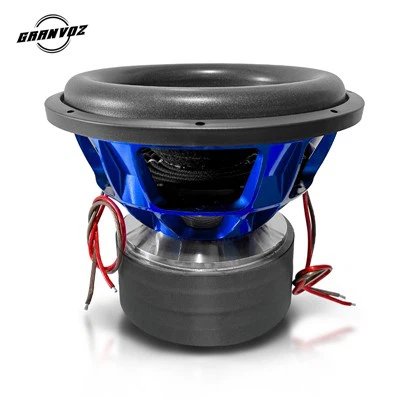
The speaker horn and the power amplifier should be matched in three ways: impedance matching, power matching and working frequency matching.
Impedance value matching, the power amplifier can withstand a certain range of impedance speaker speakers, such as 8 ohms, 16 ohms, these must match, the power amplifier can work safely and provide ideal power to the speaker speakers. Different power amplifiers can withstand different impedances. When connecting speakers, be sure to check the impedance value. Power matching, it is necessary to clearly know the rated power of the power amplifier and the rated power of the speaker speaker. The power of the power amplifier is generally about 20%-30% larger than the power of the speaker speaker. If the power of the power amplifier is too large, it is easy to cause the voice coil of the speaker to be burned.
The power of the power amplifier is less than the power of the speaker horn, which will easily cause the speaker horn to burn out, because when the maximum volume is running, the output power exceeds the power of the power amplifier, which will cause distortion, and it is easy to generate DC electrical signals. Burn the speaker horn. Frequency matching, the current power amplifier has a full-frequency power amplifier and a bass power amplifier.
The bass amplifier can ensure that the distortion is less than 1% below the frequency of 250HZ, otherwise the distortion will rise sharply. Full-frequency power amplifiers are generally classified into AB class, and the power loss is relatively large. When filtering out low-frequency signals, it can only promote the medium and high frequency speaker speakers to save power and ensure sound quality. The woofer is generally driven by a woofer amplifier.
As long as the speaker horn and the power amplifier are in accordance with the above matching principles, the two can basically be guaranteed to be in a safe state, and the sound quality of the speaker horn can be guaranteed.