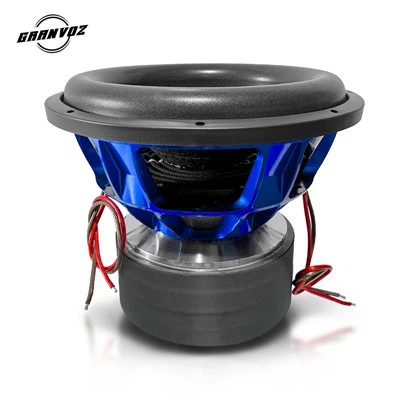
The construction of speakers is approached in the same way as musical instrument making. Fine tolerances and attention to detail make large differences to performance. Large musical instruments and speakers suit low frequencies and vice versa. Each speaker and instrument can only function efficiently with linearity within 3 octaves (octave is ratio 1:2). Theoretically a single speaker would have to change diameter from (1in - 24ft) (20mm - 8m) to maintain similar level and dispersion over the frequency spectrum.
The majority consist of paper or plastic moulded into a cone shape, loosely suspended in a frame so as to easily move back and forth to vibrate the air. Glued to the back of the cone is a coil of wire (voice coil) within a strong magnet field. Passing electricity through wire causes a magnetic field around the wire, which attracts or repels, causing the cone to move back and forth. The larger the magnet and voice coil (BL) the greater the power and efficiency if well made. Externally vibrating the cone will cause the voice coil to generate electricity. A speaker can work well as a microphone especially for bass drums.
The energy of the magnet is conducted through the mild steel pole plates and pole piece and concentrated (north - south) across the gap. Hopefully the voice coil has been perfectly centred in the gap. The clearances are very very small, less than half a bees dick. The smaller the gap - the more intense the magnetic field - the greater the efficiency. The slightest variations in alignment during manufacture, cause large variations in performance. No two speakers or musical instruments can be identical.
Voice Coils. Passing electricity through wire causes a magnetic field around the wire. Changing polarity of the electric current through the wire also changes the polarity of the magnetic field created around the wire. The interaction of the two magnetic fields, causes the voice coil to be pushed out of the gap forward or backward, depending on the polarity of the electricity through the voice coil.
Voice coil Length. At bass frequencies the voice coil has to move back and forth a long distance, especially at high power, compared to the high frequencies. During movement, the % of voice coil in the gap must remain constant. The voice coil can be long and the pole plate thin or the voice coil short and the pole plate thick to achieve the same outcome. There are argued advantages and disadvantages both ways. Mid and high frequency speakers cones only move a small distance, compared to the large movement of bass speakers. The voice coil length and pole plate thickness are similar.
Mid and high frequency speakers are approx 6dB to 10dB more efficient than bass speakers. In small passive systems the mid and high frequency speakers are attenuated to match the less efficient woofer. In active systems the bass speaker is driven with higher power. An example is two 15in woofers driven with 400 Watts to match a 12in mid speaker driven with 200 Watts.
Voice Coil Diameter. On the same diameter speaker a small voice coil has less control over the cone compared to a large voice coil. With a small voice coil the cone is able to be more resonant compared to the same size cone with a large voice coil. Some small voice coil speakers may appear to be more efficient but this extra efficiency may be only at the one resonant bass note. At frequencies above this resonant bass note the speaker may be less efficient compared to the same cone with a larger voice coil. Cost and performance of speakers increase with voice coil size.
The larger the voice coil the better the control over the cone, and therefore improved damping and linearity. Large voice coils are expensive to make (limit approx 4in 100mm). Assembling the speaker is also more difficult, tolerances taken to greater accuracy. The larger the voice coil diameter - the larger the area of the magnetic gap. To keep the flux density of the magnetic energy (per unit area) in the gap the same (for the speaker to retain the same efficiency) magnet size and therefore mass of the speaker must be increased. The major advantage of larger voice coils is greater power-handling.