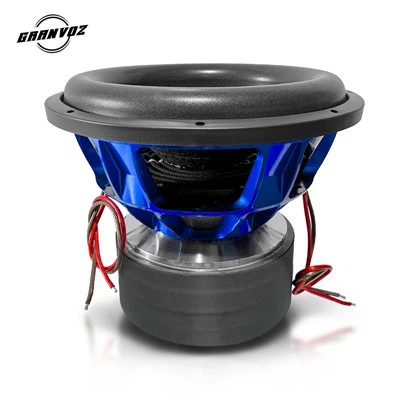
This law still holds true basically, although there are more exceptions than expected, provided that you can find an excellent subwoofer that can indeed make a pair of small bookshelves produce frequencies that are more beautiful than the ground. But generally speaking, 2.1 is still not as good as the excellent 2.0.
An excellent subwoofer is quite expensive. Most of the ones on the market can only make a loud noise. They are good for watching movies, but it's basically impossible to expect them to listen to music. However, I'm still looking for a cost-effective subwoofer, hoping that it can be paired with my small bookshelf to produce clean and basically floor-standing bass.
Perhaps, subwoofers specifically designed to enhance the low frequencies for particular bookshelf speakers for music appreciation can achieve a 2.1 effect that is better than 2.0. However, it is generally not recommended unless one has put it into practice.
Second, a small horn (box) is needed, not a large one (box).
The pursuit of large speaker diameters is just like the pursuit of large space in a car. Although for the same series of products from the same audio manufacturer, large-diameter speakers are generally significantly better than small-diameter ones. However, just like a car, if it gets a little larger, the price will immediately soar, but the driving performance will deteriorate and the fuel consumption will increase significantly. The same goes for speakers. The effect of an 8-inch speaker in a 10-square-meter area is often even inferior to that of a 5-inch one. For audio equipment, the environment is far more important than the diameter!
In conclusion, when the budget is insufficient, it is advisable to choose small-diameter speakers as much as possible. Don't worry too much about the sound not filling up. Now, a pair of excellent 5-inch speakers can fill up 20 square meters without any problem.
Third, it should be suitable, not expensive
When it comes to choosing audio equipment: The most suitable one is the best!
Audio equipment is an overall system project involving many issues: the size of the room, preferred music types, budget, front-end, and other requirements. It's not the case that the more expensive something is, the more suitable it is. Tailoring it to your body is the most appropriate. Especially the environment is really crucial to speakers. Playing with large speakers in a small environment is not necessarily bad, but it requires too much effort and money.
Is the budget important? No, it doesn't! There are dozens of desks, and it's quite nice to listen to human voices and pop music. For a budget of just over a few hundred or a few thousand yuan, you can also choose a very good audio system that can listen to human voices and string instruments. Such an expensive system has high requirements for the audio source, the environment, and the music and recording. Even good equipment, when placed in an unsuitable environment and with an inappropriate front end, can make one want to smash it. Often, the equipment itself is fine, but the problems lie in the front end, the environment and the supporting facilities, which are not in place.
Fourth, be thorough; don't do it all at once
The most common advice that beginners encounter when choosing audio equipment is: "Increase the XX budget and replace the XX audio equipment with OO audio equipment." "Get it right in one step, have fewer regrets and less trouble in the future." Does that sound good? In fact, this statement is just a pitfall. Many beginners have budgets ranging from several thousand to tens of thousands, or even more, because of this. Under the deception of a group of veteran burners, the budget for new burners soon exceeded many times over, and the final result might only be worse (see the third point above).
The meaning of "to be in place" is: Investing in a good audio system will bring you great enjoyment every day. As a music lover, it is very worthwhile to invest a certain amount of money in it. Many people's mobile phones start at several hundred yuan when they change, but they are reluctant to buy a speaker. You should know that mobile phones need to be replaced every two years, while audio systems can be used for several years or even ten years. Although it's not necessary to have a HIFI or Hi-end worth several thousand or tens of thousands of yuan, there should always be a few hundred, right? It's just like a mobile phone and can be used for many years.
Another meaning of being in place is to consider an appropriate budget based on your favorite music type, listening environment, and front-end integration. With popular vocals, including stringed instruments, a few tens of thousands is enough. Increasing the budget further won't be much better. It might even be worse. If there is only one computer or portable device for the front end, the back end doesn't have to be too good either (anything that increases your budget is a trap; improving the front end is the real deal). The environment is just around 10 square meters or even a desktop. A few thousand will do. Tens of thousands will only make a big fuss.
The meaning of "Don't achieve it in one step" is: This is an impossible thing. The reason is quite simple. What one veteran chef says in one step might just be seen by others as a way to enter the door. In the eyes of many people, a sound system with several thousand yuan is considered very expensive, but in the eyes of audiophiles, it's just a few wires. Increasing the budget to tens of thousands is quite a challenge, isn't it? In the eyes of high-end enthusiasts, it's just entry-level. 10,000 to 20,000 is quite impressive, isn't it? Soon you'll find that the old burn can only be listened to with a system that costs over 100,000.
Five, want bass, not super bass
Just like headphone enthusiasts, any headphones that require a heavy bass when they are released are just starting out (laugh). This makes sense because mid-to-high-end equipment, whether it's headphones or speakers, doesn't have heavy bass. All the equipment that promotes its deep bass as a selling point is, without exception, an entry-level one (or even not an entry-level one, just laugh).
The reason is quite simple. It's not that the bass of mid-to-high-end equipment is poor. When these devices are playing music, the bass is very powerful, especially the audio system. When playing large-scale symphonic music, the overwhelming momentum can be described as "shaking the earth and the mountains", which is not an exaggeration. However, is the low frequency heavy? Not at all. You will only feel that the low frequency is elastic, textured and stress-free.
Is low frequency important? Very important, extremely important! It's just the texture and depth of the low frequencies, as well as the speed. There are also many factors that are more important than the low frequency: the thickness and density of the mid-frequency; Three-frequency equilibrium High-frequency smoothness and correct timbre; Analytical power Sound field positioning Transparency The speed of the three frequencies... In any aspect, its importance is no less than that of low frequencies, especially in terms of the volume of low frequencies. The most important thing is the appropriate low-frequency volume!