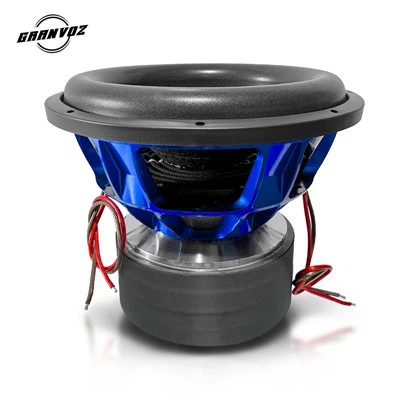
In car audio, there are many brands of speakers, and the sound of each speaker brand varies greatly, which is closely related to the different craftsmanship and materials of the speaker diaphragm. The most common materials for horn diaphragm are: paper bowl, plastic diaphragm (commonly known as PP bowl), metal diaphragm, and synthetic fiber diaphragm. In addition to these four major types of materials, there are many lightweight and high-strength materials that can be used to make horn diaphragm, such as silk fiber, wool fiber, graphite fiber, etc. Some are suitable for making high notes, some are suitable for making medium notes, some are suitable for making low notes, some are suitable for both high, medium, and low notes, each with its own characteristics.
Paper basin, this is the oldest material.
Simply put, the pulp suspension is fed into a pre designed bowl shaped mesh mold, and the pulp is deposited onto it. The pulp, which has been deposited to an appropriate thickness, is then taken out and dried for subsequent processing to form a paper bowl diaphragm. The composition of the pulp, such as the type and length of fibers, and the composition of fillers, as well as the production process and post-processing methods of papermaking (such as air drying or hot pressing), will affect the characteristics of the final product and directly affect the sound characteristics. Generally speaking, the sound characteristics of a paper basin are smooth, natural, bright, and clear. Because it contains countless fibers interwoven with each other, the energy transmitted within it can be quickly absorbed, forming good damping. Therefore, the basin splitting resonance caused in the high-frequency region of the sound frequency domain is not obvious, and the cutoff band of the roll off is also very smooth. This can be said to be a great feature because it allows for the use of a very simple frequency divider without the need for additional trimming, and the integration of the system is also very healthy. In addition, the rigidity of the paper bowl is quite good, and it performs well in the details of instantaneous response and listening sensation. Furthermore, if designed and made properly, the paper basin can be made very lightweight, over 15% lighter than the lightest plastic diaphragm. Although paper is slightly heavier than the latest high-tech synthetic fiber materials, the difference is not significant, resulting in higher sound production efficiency.
Of course, paper pots also have weaknesses, as their characteristics vary with environmental humidity. After absorbing moisture, the density of the paper increases (becomes heavier) and its rigidity decreases (becomes softer), thus affecting its sound production characteristics.
In recent years, a large part of the paper pot monomers produced have various improvement methods in this area, making the characteristics of the paper pot more stable. Common methods include surface coating or writing on paper formulas.