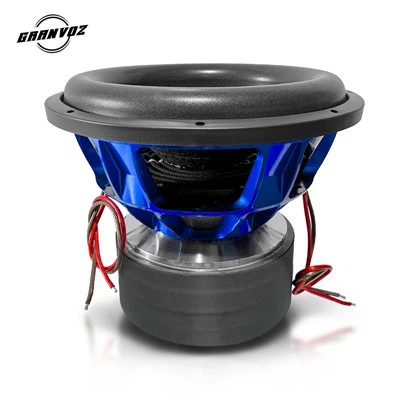
The main performance indicators of the loudspeaker are: sensitivity, frequency response, rated power, rated impedance, directivity, distortion and other parameters.
1. Rated power
The power of the speaker is divided into the nominal power and the maximum power. Nominal power refers to rated power and undistorted power. It refers to the maximum input power allowed by the speaker in the rated non-distortion range. The power marked on the speaker's trademark and technical specification is the power value. The maximum power refers to the peak power that the speaker can withstand at a certain moment. In order to ensure the reliability of the speaker, the maximum power of the speaker is required to be 2 to 3 times the nominal power.
2. Rated impedance
The impedance of the speaker is generally related to the frequency. The rated impedance refers to the impedance measured from the speaker input when the audio frequency is 400Hz. It is generally 1.2 to 1.5 times the DC resistance of the voice coil. Common impedances of moving coil speakers are 4Ω, 8Ω, 16Ω, 32Ω, etc.
3. Frequency response
When audio signals of the same voltage but different frequencies are applied to a speaker, the sound pressure produced by it will change. Generally, the sound pressure generated in the mid-range is relatively high, while the sound pressure generated in the low-range and high-range ranges is relatively small. The frequency range of high and low frequencies when the sound pressure drops to a certain value of the mid-range is called the frequency response characteristic of the speaker.
The ideal frequency characteristic of the loudspeaker should be 20-20KHz, so that all audio can be reproduced evenly, but this is impossible. Each speaker can only reproduce a certain part of the audio well.
4. Distortion
The phenomenon that the speaker cannot reproduce the original sound realistically is called distortion. There are two kinds of distortion: frequency distortion and nonlinear distortion. Frequency distortion is caused by the stronger playback of signals at certain frequencies and the weaker playback of signals at other frequencies. Distortion destroys the original high and low sound ratio and changes the original sound color. The non-linear distortion is caused by the lack of complete consistency between the vibration of the speaker vibration system and the fluctuation of the signal, and a new frequency component is added to the output sound wave.
5. Pointing characteristics
It is used to characterize the sound pressure distribution characteristics of the speaker in various directions in space. The higher the frequency, the narrower the directivity, and the larger the cone, the stronger the directivity.